Free practice › JEE Main
JEE Main · Physics · NCERT Class 12 Physics, Chapter 3
Current Electricity: JEE Main PYQ with Solutions
10 free questions on Current Electricity: 8 real JEE Main previous year questions (PYQ) and 2 practice questions, each with a step-by-step solution. Try each one first, then tap Show answer & solution.
Current Electricity is Chapter 3 of NCERT Class 12 Physics. It covers electric current and drift velocity, Ohm's law, resistivity and its change with temperature, electrical energy and power, emf and internal resistance of cells, cells in series and in parallel, Kirchhoff's rules and the Wheatstone bridge. In JEE Main, questions from this chapter are often short calculations: resistance of a stretched wire, equivalent resistance of a network, terminal voltage and current when cells have internal resistance, and power lost in a cable. Set up the formula correctly and the arithmetic is usually small.
How often does Current Electricity come in JEE Main?
In the 51 full JEE Main papers (2020–2026) in the app, 84 questions were from Current Electricity, about 1.6 per paper.
Our own count: Devika Prep Portal counted these from the past papers in the app.
8 previous year questions
Q1JEE Main 2021 — 26 Feb, Shift 2
A wire of 1 Ω has a length of 1 m. It is stretched till its length increases by 25%. The percentage change in resistance to the nearest integer is :
- (A) 76%
- (B) 56%
- (C) 25%
- (D) 12.5%
Show answer & solution
Answer: (B) 56%
Step 1: On stretching, the volume stays constant, so the area falls as the length grows: R = ρl/A = ρl²/(volume), i.e. R is proportional to l².
Step 2: New length = 1.25 l, so R' = (1.25)² R = 1.5625 R. (The change is 25%, not small, so use the exact square instead of doubling 25%.)
Step 3: Percentage change = (1.5625 − 1) × 100 = 56.25% ≈ 56%.
Final Step: The correct answer is (B).
Q2JEE Main 2022 — 30 Jun, Shift 1
An electric cable of copper has just one wire of radius 9 mm. Its resistance is 14 Ω. If this single copper wire of the cable is replaced by seven identical well insulated copper wires each of radius 3 mm connected in parallel, then the new resistance of the combination will be :
- (A) 9 Ω
- (B) 18 Ω
- (C) 28 Ω
- (D) 126 Ω
Show answer & solution
Answer: (B) 18 Ω
Step 1: For wires of the same material and length, R = ρL/A, so R is inversely proportional to the total area carrying the current.
Step 2: Single wire: A₁ = π(9 mm)² = 81π mm². Seven wires in parallel, each of radius 3 mm: total area A₂ = 7 × π(3 mm)² = 63π mm². (Each thin wire has 1/9 of the area, so seven of them give only 7/9 of the original area.)
Step 3: R₂ = R₁ × A₁/A₂ = 14 × 81/63 = 14 × 9/7 = 18 Ω.
Final Step: The correct answer is (B).
Q3JEE Main 2022 — 24 Jun, Shift 1
Two identical cells each of emf 1.5 V are connected in parallel across a parallel combination of two resistors each of resistance 20 Ω. A voltmeter connected in the circuit measures 1.2 V. The internal resistance of each cell is :
- (A) 2.5 Ω
- (B) 4 Ω
- (C) 5 Ω
- (D) 10 Ω
Show answer & solution
Answer: (C) 5 Ω
Step 1: Two identical cells in parallel act like one cell of the same emf 1.5 V with internal resistance r/2 (two equal r in parallel).
Step 2: The external resistance is 20 Ω ∥ 20 Ω = 10 Ω. The voltmeter reads the terminal voltage, 1.2 V, so the current is I = 1.2 V/10 Ω = 0.12 A.
Step 3: Terminal voltage = emf − I × (internal resistance): 1.2 = 1.5 − 0.12 × (r/2) → 0.12 × r/2 = 0.3 → r/2 = 2.5 Ω.
Step 4: r = 5 Ω. (2.5 Ω is the combined internal resistance of the pair, not that of each cell.)
Final Step: The correct answer is (C).
Q4JEE Main 2022 — 29 Jun, Shift 2
The combination of two identical cells, whether connected in series or parallel combination provides the same current through an external resistance of 2Ω. The value of internal resistance of each cell is
- (A) 2Ω
- (B) 4Ω
- (C) 6Ω
- (D) 8Ω
Show answer & solution
Answer: (A) 2Ω
Step 1: Let each cell have emf E and internal resistance r, and R = 2 Ω. In series: emf 2E, internal resistance 2r, so Is = 2E/(2r + 2).
Step 2: In parallel: emf E, internal resistance r/2, so Ip = E/(r/2 + 2) = 2E/(r + 4).
Step 3: Equal currents: 2E/(2r + 2) = 2E/(r + 4) → 2r + 2 = r + 4 → r = 2 Ω. (General result: series and parallel give the same current only when r = R.)
Final Step: The correct answer is (A).
Q5JEE Main 2022 — 24 Jun, Shift 2
What will be the most suitable combination of three resistors A = 2Ω, B = 4Ω, C = 6Ω so that (22/3)Ω is equivalent resistance of combination?
- (A) Parallel combination of A and C connected in series with B.
- (B) Parallel combination of A and B connected in series with C.
- (C) Series combination of A and C connected in parallel with B.
- (D) Series combination of B and C connected in parallel with A.
Show answer & solution
Answer: (B) Parallel combination of A and B connected in series with C.
Step 1: 22/3 Ω ≈ 7.33 Ω is more than any single resistor, so one resistor must be in series with a parallel pair. The parallel pairs are: 2 ∥ 4 = 8/6 = 4/3 Ω, 2 ∥ 6 = 12/8 = 3/2 Ω, 4 ∥ 6 = 24/10 = 12/5 Ω.
Step 2: Option (B): A ∥ B in series with C gives 4/3 + 6 = 22/3 Ω. This matches.
Step 3: Check the others: option (A) gives 3/2 + 4 = 11/2 Ω; options (C) and (D) put a series pair in parallel with the third resistor, which is always less than that single resistor (8/3 Ω and 5/3 Ω), so they cannot give 22/3 Ω.
Final Step: The correct answer is (B).
Q6JEE Main 2020 — 2 Sep, Shift 1
Consider four conducting materials copper, tungsten, mercury and aluminium with resistivity ρC, ρT, ρM and ρA respectively. Then :
- (A) ρC > ρA > ρT
- (B) ρA > ρT > ρC
- (C) ρA > ρM > ρC
- (D) ρM > ρA > ρC
Show answer & solution
Answer: (D) ρM > ρA > ρC
Step 1: At room temperature: copper ≈ 1.7 × 10⁻⁸, aluminium ≈ 2.7 × 10⁻⁸, tungsten ≈ 5.6 × 10⁻⁸, mercury ≈ 98 × 10⁻⁸ Ω m.
Step 2: Only ρM > ρA > ρC is consistent.
Final Step: The correct answer is (D).
Q7JEE Main 2021 — 24 Feb, Shift 1
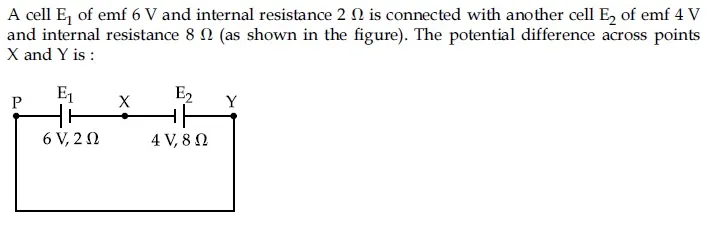
A cell E₁ of emf 6 V and internal resistance 2 Ω is connected with another cell E₂ of emf 4 V and internal resistance 8 Ω (as shown in the figure). The potential difference across points X and Y is :
- (A) 2.0 V
- (B) 3.6 V
- (C) 5.6 V
- (D) 10.0 V
Show answer & solution
Answer: (C) 5.6 V
Step 1: The cells oppose each other in the loop: I = (6 − 4)/(2 + 8) = 0.2 A.
Step 2: E₂ is being charged: V = 4 + 0.2 × 8 = 5.6 V (also 6 − 0.2 × 2 = 5.6 V).
Final Step: The correct answer is (C).
Q8JEE Main 2023 — 10 Apr, Shift 1
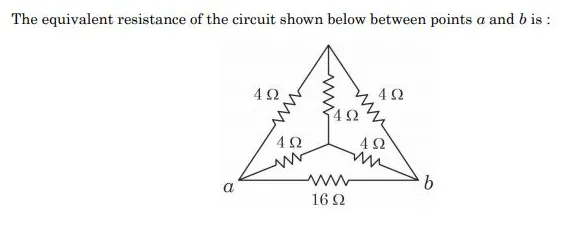
The equivalent resistance of the circuit shown below between points a and b is :
- (A) 16 Ω
- (B) 20 Ω
- (C) 24 Ω
- (D) 3.2 Ω
Show answer & solution
Answer: (D) 3.2 Ω
Step 1: By symmetry the top vertex and the centre are at the same potential, so the 4 Ω between them carries no current.
Step 2: Paths a–top–b (8 Ω), a–centre–b (8 Ω) and the 16 Ω are in parallel: 1/R = 1/8 + 1/8 + 1/16 = 5/16.
Final Step: R = 3.2 Ω. The correct answer is (D).
2 more practice questions (Devika Original)
Written by Devika Prep Portal from the NCERT textbook in the JEE Main pattern. These are not past-paper questions.
Q9Devika Original (NCERT-based practice)
A power of 100 kW is delivered to a town through cables of total resistance 5 Ω. If the power is transmitted at 10 kV, the power wasted in the cables is:
- (A) 500 W
- (B) 5 kW
- (C) 50 kW
- (D) 50 W
Show answer & solution
Answer: (A) 500 W
Step 1: Current in the cables I = P/V = 100 × 10³/10 × 10³ = 10 A.
Step 2: Power wasted Pc = I²Rc = 10² × 5 = 500 W. (At 1 kV it would be 50 kW — Pc ∝ 1/V².)
Q10Devika Original (NCERT-based practice)
Two cells of emf 2 V and 1 V, each of internal resistance 1 Ω, are connected in parallel with their positive terminals joined together. The emf of the equivalent cell is:
- (A) 1 V
- (B) 1.5 V
- (C) 2 V
- (D) 3 V
Show answer & solution
Answer: (B) 1.5 V
Step 1: 1/req = 1/1 + 1/1, so req = 0.5 Ω.
Step 2: εeq/req = ε₁/r₁ + ε₂/r₂ = 2 + 1 = 3, so εeq = 3 × 0.5 = 1.5 V.
3 common mistakes in Current Electricity
- Stretching a wire: using R ∝ l and forgetting the area. When a wire is stretched, its volume stays the same, so the area becomes smaller as the length grows. From R = ρl/A with A = volume/l, we get R = ρl²/volume, so R ∝ l². A wire made 25% longer has (1.25)² = 1.5625 times the resistance, not 1.25 times.
- Cells in parallel: adding the emfs. Emfs add only in series (n identical cells in series, all connected the same way round, give nε and internal resistance nr). For n identical cells in parallel, the emf stays ε and only the internal resistance drops to r/n. If the cells are different, use εeq/req = ε1/r1 + ε2/r2 with 1/req = 1/r1 + 1/r2.
- Taking the voltmeter reading as the emf. An ideal voltmeter across a cell reads the terminal voltage, which equals the emf only when no current flows. When the cell supplies a current I, V = ε − Ir; when it is being charged, V = ε + Ir. Always write the current first, then find V from it.
Current Electricity formula sheet →
Practise the full chapter
Chapter-wise questions in NCERT order, full past papers and mock tests, all with solutions.
Start free — 8 days